DISCLAIMER / AVERTISSEMENT / HAFTUNGSAUSSCHLUSS

And that's not about NSFW - even though, for some people, the information below might also seem not SFW.
You are visiting our LEGACY & RUST page, where LEGACY is about our legacy, and RUST just sounds more poetic, as our legacy never rusts - nor do we.
But - read our disclaimer, as the things we write here are sensitive not only for us.
Legacy is history, and history is a weird thing. History is not mother, father, sister, or brother.
Our factory is located in Riga, Latvia, in the heart of the Baltic countries. It has - let’s count - two ages of history. And it is located at the crossroads of many countries’ interests. Being small but strategically located, it was always a tasty dish for different conquerors - tzars, emperors, dictators, whites, reds, nazis, and once even soldiers of fortune.
It was independent for a little more than five decades - from 1920 to 1940, and from 1991 till now. During that time, being conquered and occupied, not only the country but our factory used other countries’ symbols.
In current times and the current situation, some symbols, words, and even letters that were acceptable before 24.02.2022 are not acceptable now.
That’s one side of the coin.
Another - we cannot and we will not rewrite history. We can try to forget it. We can dream of painting some pages black - but we cannot change it.
Because of history, some of our colleagues became “younger,” cutting decades off their own history and legacy, trying to erase their past. Some changed their family names, not to be a red flag for other countries.
We will not erase our past, and we will not forget it. It is our past, and it is our foundation.
Yes, we changed our name - but not because of shame. We exchanged one historical name for another, making it sound more modern.
We are proud of our genius engineers, racers, and - as these people are called now - “managers,” as these people are not only our heritage; these people moved the world ahead.
Our ancestors’ factory, RBVZ JV, was the starting point for such well-known persons as Igor Sikorsky, the Godfather of the helicopter - yes, he was an engineer and later Head of the Aeronautical Department - and André Nágel, racer, writer, adventurer, journalist, and engineer.
A man who came first at Monte Carlo 1912, and some of whose results are still unbeatable. A man who conquered Vesuvio and Dakar. These people became the faces of our brand identity - The Spirit of Victors.
Both of these men had to run away after the October Junta of 1917 won and started brutally annihilating the intelligentsia. Among them was RBVZ JV founder and biggest shareholder Igor Shidlowsky, who was brutally murdered with his son by the reds while trying to escape to Finland. And that is also part of our factory’s history.
The world also knows other famous persons related to RBVZ - such people as the Nobel brothers from Sweden, or philosopher Isaiah Berlin from Riga, or French driver and engineer Adolf Kegresse.
We can’t say anything about the RBVZ Department of Opulence representative - relatives of the world-famous Jacob Davis, or Yakov Jufess, as he was called in Riga - the inventor of Levi’s Jeans. We can’t follow their destiny, but we can be proud to follow their path and traditions in interior and uniform craftsmanship.
The history of our factory is not about regimes and occupation periods. The history of our factory is about the human brain and bravery, which we proudly inherited and revived.
And - if you see some sensitive images like the Russian Imperial Eagle, some Russian or German texts, or the letter Z, which means for us nothing more than Zavod (factory in Russian) - and also the last letter of the Latin alphabet, symbolizing “top of the tops” - please know: this is just part of history. We can’t unring the bell.
Factory inheritor-reviver, grandson of the First Republic Riga Chief Engineer, engineer-mechanic Zalman Anticol, Leonard F. Yankelovich, is doing all to keep the world’s oldest - and for sure smallest - car manufacturer as the “biggest” and loudest.
Royal Carriages & EV’s. FRESE & NELLIS. Founded 1827

1827
Department G. Group 83. Classes 515–517.
392. NELLIS and FRESE.
St. Petersburg.
Carriage Builder
Established in 1827. Value of yearly production 250,000 roubles. Handwork. 12 forges, steam engine (2½ H.P.), drilling and turning lathes and other appliances; 150 workmen. Steel and varnish received from England, silk stuff and leather from France, timber from America and Germany. Sale in Russia, mostly in St. Petersburg.

1856
Coronation Carriages.
Built in St. Petersburg in 1856. Took part in the coronation processions of Emperors Alexander II, Alexander III, and Nicholas II.
1866
Daily Travel Carriage with Umbrella, 1866
Crafted in 1866 at the Karl Karlovich Nellis Carriage Factory in Saint Petersburg, this opulent carriage was the daily travel companion of Maria Feodorovna, wife of Emperor Alexander III. Its retractable umbrella allowed the Empress to move through the city in style, rain or shine. A true symbol of opulent craftsmanship and timeless elegance, it embodies the spirit that inspires today’s bespoke DARTZ vehicles.

1899
Was renamed to Joint-Stock Company for the Construction and Operation of Carriages and Automobiles
FRESE & Co.
The carriage factory Frese & Co., originally belonging to K. K. Nellis, was founded in 1827, and after the owner’s death passed to his son-in-law, K. K. Frese, who greatly expanded its production. The factory has been producing carriages of all kinds. The factory’s brand became widely known in Russia for its excellent materials and artistic craftsmanship.
In 1895, the factory began manufacturing automobiles, and in 1902 it produced the first electric automobile in Russia, which aroused great interest both domestically and abroad.
1902
Pioneers of Electric Mobility
In 1896, the Frese & Co. factory expanded from crafting fine carriages to building automobiles — marking the beginning of a new era in motion.
By 1902, the company created the first electric automobile in Eastern Europe, a breakthrough that captured attention across the continent and beyond. That same year, Frese & Co. showcased its innovations at the World Exhibition in Paris, earning international recognition for engineering excellence and visionary design.
Combining artistry with technology, the factory soon mastered both electric and gasoline-powered vehicles, establishing an early legacy in electric mobility that would later inspire generations of automotive engineers.
Frese & Co. remains a symbol of how timeless craftsmanship and forward-thinking innovation can coexist — from the elegance of the carriage age to the dawn of electric transportation.

1902
In 1902, the Frese factory built an innovative electric truck weighing only 820 kg, notable for requiring no onboard batteries. The vehicle was based on a standard Frese truck but was equipped with an electric motor powered by high-voltage current supplied through overhead wires, a system patented by the German company Telegraphen-Bauanstalt Siemens und Halske AG. The current was collected using a "contact trolley," a French design by inventor Lombard-Gérin, which rolled along the wires. The magazine Automobile reported on tests of the vehicle that year, highlighting that it ran not on rails but on ordinary roads, making it one of the earliest examples of an electric road vehicle intended for cargo transport. Present at the successful tests were P. A. Frese, Minister M. I. Khilkov, Prince P. D. Lvov - credited as the designer of the spring suspension - and A. P. Nagel, editor of Automobile.

1903
By 1903 , Frese had already built approximately 120 automobiles. By this time, Frese had already transformed from an automobile assembly plant into a fully-fledged automobile factory, employing over 100 workers and employees. The company had opened a branch in Warsaw . The "Frese and Co. Joint-Stock Company for the Construction and Operation of Automobiles" built virtually all of its own automobiles, including the chassis. Only engines, transmissions, and other more complex components remained imported. It was one of the most significant Russian automobile companies of the early 20th century.
In the autumn of 1903, G. G. Eliseev and P. A. Frese proposed a project to establish the "Black Sea Society for Mechanical Trackless Transportation and Electrical Energy" .

1904
Frese pioneered electric vehicles for postal, military, and commercial use. In 1903, the St. Petersburg Post Office ordered 14 electric mail vans, designed with short-wheelbase chassis for maneuvering tight alleys, motorcycle-type wheels, and speeds of 18 km/h, making mail delivery faster than horse-drawn vans. Frese assumed full responsibility for their operation and maintenance.
In 1904, the factory built one of Russia’s first electric fire engines for the Alexander Nevsky Fire Department of St. Petersburg. The vehicle carried 10 firefighters, hoses, and ladders, and on its first day of service arrived 12 minutes ahead of horse-drawn wagons, proving the practicality of electric power for emergency response. That same year, Frese supplied electric vans and trucks to commercial clients, including St. Petersburg’s "Georges Borman" confectionery and other industrial customers, showcasing the versatility of electric vehicles in both urban and professional applications.

1910
In 1910, Frese sold his company to the Automobile Department of RBVZ JV in Riga - formally allowing us to trace our heritage back to 1827. But let’s not be so formal: what was born in Riga will always stay in Riga. That’s RBVZ, and today it’s DARTZ, founded in 1869. Pressed by storms of history, the DARTZ inheritor-revivee resurrected the FRESE & Co label, modernized it as FRÉZÉ EV, and brought it back to life in 2020. The first EVs cassosseried by the DARTZ EV Department hit the roads in 2022, celebrating a true Century Anniversary. For more information about our EVs, visit FREZE.co.
Imperial Train Coaches. RBVZ. Established 1869, Riga

1869
The Russo-Baltic Wagon Factory (German: Russisch-Baltische Waggonfabrik; Russian: Русско-Балтийский вагонный завод, RBVZ) was founded in 1869 in Riga, then a major industrial center of the Russian Empire. Originally, it was an affiliate of Van der Zypen & Charlier in Cologne-Deutz, Germany, specializing in the production of railway carriages. Responding to a large Russian order for 500 carriages, the company established a manufacturing facility at Valmieras Street 2 in Riga, bypassing customs duties for direct delivery to the Empire. In addition to these large-scale orders, the factory produced imperial railway carriages for European royal families, crafted with unparalleled luxury and opulence, exceeding even the highest standards of the era.

1869 - 1874
From the very beginning, RBVZ focused on crafting exceptional railway carriages, from practical passenger and freight wagons to the most luxurious imperial train coaches. The establishment of the factory in Riga not only fueled the city’s industrial growth but also positioned it as a center of unrivaled railway craftsmanship.
1874
As the Russian Empire’s rail network expanded, the demand for all types of railway carriages - from practical freight wagons to opulent imperial coaches - grew rapidly. The factory in Riga thrived, its reputation for exceptional craftsmanship and luxury spreading across the empire and beyond. Faced with this booming demand, the owners of RBVZ recognized the need for greater resources, capital, and organizational structure to scale production and meet the expectations of elite clients.
In response, they made the pivotal decision to go public, transforming the company into a joint-stock enterprise. This strategic move allowed RBVZ to attract new investors, expand its facilities, and solidify its position as a premier manufacturer of railway carriages, capable of serving both the growing empire and the most prestigious royal households of Europe.

1888
In 1888, the imperial train of Russian Emperor Alexander III was rocked by an explosion. A bomb, allegedly planted by the assistant cook linked to revolutionary groups like Narodnaya Volya, went off during the Tsar’s breakfast. The cook quietly disembarked before the blast and vanished abroad.
Eyewitnesses recalled the train jolting violently, with the dining car torn apart and half the carriage blown away. The official story blamed track failure -likely to avoid inspiring copycats.
After this shocking event, RBVZ JV in Riga established an Armoring Department. From then on, royal carriages were not only luxurious but also protected - laying the foundation for the DARTZ legacy
1891 - 1894
The imperial family was unharmed, but the shocking crash became the catalyst for designing a new, safer imperial train. Between 1891 and 1894, a team of specialists led by engineer-technologist Nikolai Leonidovich Shchukin, who balanced teaching at the Military Engineering Academy with consulting at the St. Petersburg Alexandrovsky Factory, developed the design.
The train was built in 1896–1897 in three complete sets: two duplicates for the Russian gauge (1524 mm) and one for international travel with the standard gauge (1435 mm). A specialized mechanism allowed bogies to be switched between different gauges when needed.
These luxurious and secure trains were used not only by the Russian imperial family but also supplied to their cousins across Europe and the United Kingdom, allowing royal relatives to travel in the same unmatched comfort and protection, whether on domestic routes or international rail journeys. From the outset, security was paramount, with reinforced structures, armored compartments, and safeguarded interiors ensuring the royal passengers were protected from potential sabotage, without compromising the elegance and opulence expected of imperial travel.
1894
In 1894, the Russo-Baltic Wagon Factory (RBVZ) entered a new era when most of its shares were sold to investors from Riga and St. Petersburg. Among them were Baltic German industrialists F. Meyer, K. Amelung, and Chr. Schroeder, whose expertise strengthened the company’s leadership in carriage manufacturing.
The shareholder circle also included the Swedish Nobel family, bringing their engineering innovation and European reach, and Schaje Berlin, a Riga financier and a relative of Isaiah Berlin born in RIga British philosopher - all reflecting the cosmopolitan spirit of the Baltic’s industrial elite.
Among them stood Gershn Antikol, great-grandfather of today’s RBVZ/DARTZ inheritor-reviver, Leonard F. Yankelovich, who held 40 shares and 8 votes. Under this visionary mix of shareholders, RBVZ expanded rapidly, employing over 3,800 workers across 50 workshops, earning the Imperial State Emblem for exceptional quality.
And even as descendants of a minority shareholder, we rightfully recognize DARTZ as the legitimate inheritor of RBVZ’s industrial and mental legacy.
What was born in Riga remains alive in Riga - the same spirit of precision, opulence, and defiance now reborn in DARTZ.

1896
Construction of Tsar Nicholas II’s imperial train began. From the very first designs, the goal was clear: Opulence and safety. Every detail was crafted by the RBVZ Department of Opulence, a dedicated team of artisans and specialists that had been part of the factory since its founding, ensuring that each carriage reflected the pinnacle of imperial craftsmanship.
The Empress’s private suite was adorned with blue silk walls in capitonné technique, satinwood paneling, and furniture that included a hammock-style bed, desk, chairs, soft armchairs, and a vanity with mirror. The bathroom was extraordinary: a bimetallic bathtub from Paris, with copper on the outside and silver inside, complete with a shower. Walls were covered with fine matting, floors with multi-layered felt and velvet carpets, and all furnishings richly upholstered.

1900
The enterprise grew rapidly. It had 553 machines, and over 4,000 workers were employed across 50 workshops, with annual production valued at nearly 11 million rubles. In 1900, the factory produced 5,513 freight carriages and 219 passenger carriages.
The quality of its products was exceptionally high—at two All-Russian Industrial Exhibitions (1882 and 1896), RBVZ was granted the right to display the mark of All-Russian recognition on its products: the state emblem of the Empire.

1906
An important figure in the factory’s history was Mikhail Vladimirovich Shidlovsky. Born in 1856 into a noble family, he initially pursued a career as a naval officer. Unexpectedly, at the rank of Captain 2nd Rank, he left a promising naval career for civil service, joining the Department of the State Treasury. There, he also achieved success, eventually holding the responsible post of Treasury Secretary.
Then, unexpectedly for many, Mikhail Vladimirovich resigned and became a private entrepreneur, taking the position of Chairman of the Board of the RBVZ Joint-Stock Company. Notably, he assumed leadership of the enterprise during a crisis period. The energetic new chairman proposed an unexpected plan to the shareholders for overcoming the crisis: reforming management methods and expanding the company’s scope of activities.
Under his leadership, RBVZ, in addition to railway carriages, began producing trams, internal combustion engines (“oil motors”), artillery carriages with charge boxes, and agricultural machinery such as automatic threshers and hay binders. After the October Junta, the major shareholder of RBVZ faced a tragic fate.
According to one version, Mikhail Vladimirovich Shidlovsky and his 18-year-old son were shot by soldiers in August 1918 while crossing the Finnish border. However, documents from Criminal Case No. 9964 in the archive of the FSB Directorate for St. Petersburg and Leningrad Region state that he was arrested in 1919 by the Cheka on charges of espionage and was executed on January 14, 1921.
In 1998, he was officially rehabilitated in Russia as someone who had been unjustly repressed.

1907
In 1907, under the initiative of Mikhail Shidlovsky, work began on establishing an automobile production line at the Russo-Baltic Wagon Factory (RBVZ). By 1908, a dedicated Automobile Department had been formed under the leadership of I. A. Fryazinovsky.
The RBVZ management approached the organization of this new division with exceptional precision. A special workshop was constructed in the southern part of the factory, equipped with 142 state-of-the-art machines, ensuring high accuracy in component manufacturing. The assembly area was large enough to accommodate the simultaneous production of up to 40 automobiles.
In total, the RBVZ Automobile Department employed 154 people, including 10 engineers, 3 test drivers, and 141 workers, as well as its own mechanical and testing laboratories.
The mention of these laboratories is significant: unlike many enterprises that relied on foreign licenses, RBVZ leadership focused from the very beginning on developing vehicles of its own design. Though more complex than licensed production, this approach allowed RBVZ to create automobiles that rivaled — and often surpassed — the finest foreign models.
From the outset, RBVZ aimed for the highest standards of quality, one hallmark being the complete interchangeability of parts within a series — an achievement that placed the Riga factory among the global elite. It became the third manufacturer in the world, after Ford and Cadillac, to reach such a level of engineering precision.
From Carriages and Train Coaches to Cars. 1909. D.A.R. Riga

1908
Following General Shidlovsky’s plans in 1908, RBVZ began preparing to enter the new era of automobiles. A letter to the Automobile Division, dated December 13, 1908, demonstrates the formal style of correspondence that defined the company.
D.A.R. – Division Automobile Riga
- that's how was temporary called RBVZ Automobile Department at 1908 marking the transition from traditional carriage craftsmanship to the automobile age.
DARTZ – The Modern Rebirth (1988)
Exactly eight decades later, in 1988, the name DARTZ was reborn, building directly on this heritage. The modern name deliberately combines:
D.A.R. – honoring the historic name and its legac
T – Tank – reflecting expertise in armored vehicles and robust engineering, with a nod to RBVZ’s early work on armored technology and worlds first tank built [still debatable].
Z – Zavod – the Russian word for “factory,” (please see our disclaimer regarding terminology)
Thus, DARTZ is not just a name—it is a symbolic bridge linking over a century of engineering: from imperial carriages to GBOL armored car technology. The name carries the legacy of RBVZ while projecting the modern spirit of innovation, resilience, and opulence.
This historical continuity, visually confirmed in the attached image, shows that DARTZ is a legitimate and deliberate evolution of RBVZ’s pioneering spirit—a name that embodies the company’s enduring craftsmanship and forward-looking vision.
1909
Julien Potterat – Young Visionary of RBVZ Automobiles
At 26, Swiss engineer Julien Potterat became Director and principal designer of RBVZ’s Automobile Department. Previously at Automobiles Charles Fondu in Brussels, he brought proven design solutions to Riga, helping shape the company’s first automobiles.
His early RBVZ cars featured a chassis inspired by Fondu designs, a 4.5-liter four-cylinder engine (30–40 hp), a mechanical hand brake, Zenith carburetor, and a three-speed gearbox, later upgraded to four speeds with a driveshaft—then a cutting-edge innovation.
Potterat’s designs combined Swiss precision, Belgian experience, and Rigan craftsmanship.

June, 8, 1909
On this day, at the RBVZ factory in Riga, the first Rigan serial-production automobile rolled off the assembly line: the “Russo-Balt” C24. Behind the wheel was the young Swiss engineer Julien Potterat, whose vision and skill had guided its creation.
The C24 quickly gained fame around the world, symbolizing a bold leap into the age of automobiles. Yet this was just the beginning: the spirit of RBVZ carried on far beyond the roads of Riga. Its legacy of engineering excellence and adventure propelled RBVZ into the skies with pioneering aircraft, and decades later, into the final frontier of space, leaving a mark on history that transcended generations.

December, 31, 1911
On this day, a legend began his journey - André Nágel, famed racer, writer, journalist, adventurer, and fighter, a true Victor and one of the shining icons of the DARTZ Spirit of Victors, serving as Chief of the RBVZ racing team.
He raced into history at the Monte Carlo Rally, 1912, crossing the line first, yet denied the crown by penalties. Still, he carved records that remain untouchable - one of them: he began the 1912 Rally in 1911. These feats of courage and skill demand their own story - a tale of relentless pursuit, daring spirit, and undeniable victory in the hearts of those who dare to chase greatness.
His story deserves a separate page

1912
From 1912, RBVZ began supplying automobiles to the Russian Army. The RBVZ vehicles took part in maneuvers and endurance tests organized by the War Department, proving their robust engineering, reliability, and performance alongside the best foreign cars of the time.
These trials tested vehicles over long distances, rough terrain, and extreme conditions, demonstrating RBVZ’s precision craftsmanship and versatility. This era laid the foundation for RBVZ’s legacy in innovation, resilience, and engineering excellence, a legacy that continues in the modern DARTZ brand.

1913
A.A. Kégresse - Inventor of the Worlds First Snowmobile
Born in Héricourt, educated in Montbéliard, and trained in the military, Adolphe Kégresse moved to Saint Petersburg in 1905 to work for Tsar Nicholas II. To improve the mobility of the imperial car park, he invented the Kégresse track, transforming ordinary cars into half-tracks capable of tackling deep snow.
He built the first prototype on an RBVZ chassis, using skis on the front and a tracked drive at the rear. By 1913, improved rubber tracks allowed RBVZ vehicles to glide over snow with unprecedented ease - creating the world’s first practical snowmobile.

1914
In 1914, RBVZ began producing armored cars based on the C24 platform, marking the company’s first venture into armed military vehicles. Extensive tests demonstrated exceptional performance for the era, showing that RBVZ’s craftsmanship and innovative engineering could support mounted weapons and withstand battlefield conditions.
By October 19, 1914, the first platoon of RBVZ armored cars, equipped with machine guns , was officially presented and sworn in before Emperor Nicholas II. This historic moment not only reinforced the Army’s capabilities but also established RBVZ as a pioneer in armored vehicle design, battlefield innovation, and military engineering excellence.

1915
Worlds first* [?] tank.
In August 1914, master engineer Alexander Porokhovshchikov of RBVZ in Riga approached the Army’s Command with a proposal: an original design for a high-speed, all-terrain combat vehicle. Same time, he also submitted his idea to the Special Committee for Naval Reinforcement, promising to create an armored all-terrain machine on tracks.
The inventor already had completed blueprints and a cost estimate for the combat vehicle, which he called the “Vezdekhod”.
The project was approved, and on January 13, 1915, construction permission was granted. By February 1, 1915, work had begun in the RBVZ auto-repair workshops in Riga.
*This is still debatable, but that can be the world’s first tank

1915
By autumn 1915, as German forces approached Riga, the imperial authorities ordered the evacuation of all RBVZ automotive production to Moscow. Many workers and engineers were uprooted—some became refugees, while others lost their livelihoods and professional skills.
The Riga workshops were abandoned and, by the early 1920s, taken over by small artisan shops. Meanwhile, the evacuated RBVZ operations in 1916 found a new home at the Petrovskoye-Fili estate, ensuring the survival of the company and its legacy. This marked the end of the RBVZ era in Riga, while the company’s DNA lived on, beginning the short BTAZ era in Russia.

1922
RBVZ Becomes the First State Armored Vehicle Factory (BTAZ)
During the revolutionary period, the Soviet government nationalized RBVZ, renaming it the First State Armored Vehicle Factory (1st BTAZ) and focusing on military production. Early Soviet armored cars, like the Prombron - which means “Industrial Armor” - were modified versions of pre-revolutionary RBVZ S-24/40 models and represent another part of the DARTZ car naming heritage.
The first Prombron, assembled on October 8, 1922, was presented to M.I. Kalinin, and another to L. Trotsky, followed by additional vehicles, two of which completed a 1990 km All-Union test run in 1923.
From Cars to Wings: RBVZ Aeronautics & Sikorsky, 1911

1911
In 1911, RBVZ launched its aeronautical production, marking the company’s bold entry into aviation. The new department initially produced French Sommer-designed aircraft under license, blending RBVZ’s precision engineering with cutting-edge aeronautical technology.
The aviation division expanded to meet a major military contract, producing Farman and Blériot airplanes - a testament to RBVZ’s growing reputation as a pioneer not just on roads and rails, but in the skies.

1912
But RBVZ managerment wanted more. They decided to create their own design bureau, appointing the young Kiev-born engineer Igor Ivanovich Sikorsky, who had worked since 1911 as an engineer in the RBVZ Aeronautical Department, as its head. The move was bold and risky, as Sikorsky didn’t even hold an engineering degree.
The gamble paid off. By 1913, his aircraft S-10 and S-11 had already taken first and second place in a military department competition, proving the brilliance of rising aeronautical talent.

1913
RBVZ’s Aeronautical Triumph: The World’s First Multi-Engine Aircraft
The crowning achievement of the RBVZ Aeronautical Department was the creation of the world’s first multi-engine airplanes. At the time, many experts believed it was impossible to build a large aircraft with multiple engines. Yet on April 27, 1913, the four-engine “Grand” took to the skies for its first flight, later renamed the “Russky Vityaz”.
Following this experimental success came a new aircraft capable of long-range reconnaissance and heavy bombing: the legendary “Ilya Muromets”. Until 1915, no other country had aircraft of this type. During World War I, these planes formed the world’s first heavy aviation unit - the Airship Squadron, commanded by General Shidlovsky, who had returned to military service.
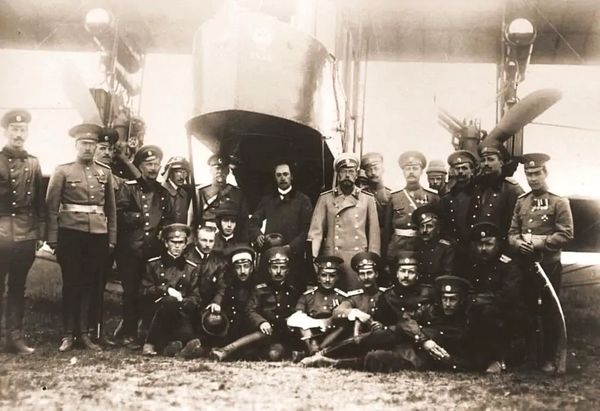
December, 23, 1914
On 23 December 1914, Tsar Nicholas II sanctioned the formation of a squadron of heavy aircraft. The decision followed his inspection of Igor Sikorsky’s pioneering Russian Knight, first built in 1913. Designed at a time when airplanes rarely lifted more than 500 kilograms, Sikorsky’s creation represented a breakthrough in aviation and became a source of national pride.

1917
Igor Sikorsky, like André Nágel, whose legacy embodies courage and daring, became an icon of DARTZ Brand Identity - The Spirit of Victors. After the October Junta of 1917, one of his former colleagues, now aligned with the Bolsheviks, warned him: “The situation is extremely dangerous. I’ve seen the order for your execution.”
Sikorsky represented a double threat to the Bolsheviks: a loyal friend of the Tsar and a beloved public figure. The people of Petrograd admired him, and Nicholas II himself had come to watch the young pilot fly. During the Red Terror, when executions were carried out on the spot, Sikorsky took the threat seriously, abandoning his Petersburg apartment and hiding in the hangars of the airfield to evade arrest.
From Carriages to ROCK’ets: The Spirit That Never Parked
SPACE AGES
From Carriages to the Rockets - The Incredible Journey and DARTZ Legacy
The most astonishing chapter in RBVZ’s history is the fate of its final masterpiece - the giant factory in Fili, near Moscow, known as BTAZ. In the early 1920s, this state-of-the-art facility was repurposed for aircraft production and later for aerospace engineering, becoming a cornerstone of Soviet aviation and space technology. Today, the former RBVZ 2nd Auto Plant is the Khrunichev State Research and Production Space Center, a key player in the legendary Soyuz–Apollo program.
This remarkable trajectory shows how Riga’s industrial heritage shaped the aerospace industry of a neighboring country. Our colleagues are proud of their aviation roots and connections, and we can declare without hesitation: DARTZ is linked to the cosmos.
One & Only.
Yet Riga’s own story of innovation would have faded into obscurity if not for the inheritor-reviver, Leonard F. Yankelovich, who not only raised the fallen flag of his ancestors, but also hoisted it to extraordinary heights, ensuring that the legacy of RBVZ continues to inspire engineering, innovation, and The Spirit of Victors.
RBVZ ReInCAR’nation - Back to Fame, the DARTZ Way.

1988
RAF Labbé — The First Car of a New Era
Since 1988, DARTZ has taken part in the development of an armored vehicle based on the Soviet van RAF 2203 Latvija, in collaboration with Coopération Labbé from Lamballe, France.
Together, they achieved the impossible — creating the first civilian cash-in-transit armored cars in the USSR, which soon appeared on Soviet roads.
This marked the beginning of the legendary DARTZ “Ruler Design” Ⓓ philosophy — and also DARTZ’s debut as a movie car manufacturer.
1993
The Birth of the Legendary DARTZ VW Froggy
DARTZ VW Froggy began soon after - one of the most advanced VW Käfers of its time.
In 1993, it featured innovations far ahead of its era, including a TV and a video player - a true rarity for that period.
The company and the car attracted the attention of our long-time friend, adviser, and inspirer - the legendary Wall Street shark and adventurer Jim Rogers.
Today, the DARTZ VW Froggy serves as a monument in a Dino Park
1994
The DARTZ Golden Calf Beach Buggy
The creation of the DARTZ Golden Calf Beach Buggy soon followed. Later, it became the inspiration for the FREZE EV BeachStar Roadster and the FREZE EV Froggy Roadster.
The name “Golden Calf” came from the aluminium golden calf skull mounted on the car’s roll cage — a bold emblem of strength and fertility, symbolizing both creative power and enduring vitality.
1995
DARTZ Star Kombat / SpaceBaller
In 1995, we began creating our largest vehicle, which would later become the first model in the legendary Kombat series.
At the same time, inspired by our love for Mel Brooks’ comedy's and our relation to Space, the car carried a second name - SpaceBaller.
Today, building such a machine might seem simple, but back in 1995, there were no AutoCAD programs - not even proper computers.
Just imagine.
1999
DARTZ & The Millennium Adventure
DARTZ took part in Jim’s and Page’s Millennium Adventure with the Mercedes Millennium Adventure vehicle.
We still have plans to create an Anniversary Edition of this beast — but we simply haven’t found the time yet.
And now, it wouldn’t even be a challenge — every garage boy can do that.
A Herald of Past Triumphs, A Beacon of Future Power

DARTZ GRUPA THE COAT OF ARMS - THE CROWN OF AN UNBROKEN LEGACY.
DARTZ MOTORZ THE SPIRIT OF VICTORS - THE SUPREME DIAMOND OF THAT CROWN.
DARTZ Grupa corporate coat of arms embodies BulletProof Opulence™, Royal Craftsmanship, and the undefeated lineage behind The Spirit of Victors - DARTZ Motorz brand identity. It is not merely a logo, it's even more than Coat Of Arms - It is a dynasty cast beyond time.
THE HEART - THE SPIRIT OF VICTORS
At the center stands the winged metal Art Deco Skull, encased in a sacred octagon - the official DARTZ Motorz badge. Forged in cold metallic brilliance, this helmeted Pilot & Racer Skull - a tribute to pilot Igor Sikorsky and racer André Nágel - is not a symbol of death. It is the eternal face of those who refuse to die, embodying the unbroken spirit of Victors.
A visage that declares the eternity of DARTZ - a life that began in 1869 and continues, unstoppable, even was stopped, to this very day.
A visage shaped from train wheels, it honors the company’s origins as a historic railway and coachbuilding manufacturer - RBVZ - and binds that industrial ancestry to the unstoppable modernity of DARTZ Motorz. Its wings echo the aviation courage of RBVZ pioneers; its armored helmet reflects the defiant strength of DARTZ creators; its fixed stare represents every Engineer, Racer, Aviator, Warrior and Victor who shaped the road from 1869 to today.
Behind it burns a golden Art Deco sunburst - a medal of valor, a coronation of heritage. Piercing downward, a solemn sword proclaims fearlessness, honor, and triumph over adversity.
THE GUARDIANS - GRIFFINS OF RIGA
Flanking this core identity are two golden griffins, standing over crossed cannons - mythic beasts fused with military power. Each occupies the heart of a mechanical gauge - one speedometer, one tachometer - merging mythic strength with modern era mechanical soul.These Golden Griffins are also the proud symbol of Riga, birthplace of the DARTZ legacy. Within their design hides a subtle letter V - a coded tribute to the two iconic Victors whose Spirits define the brand:
Igor Sikorsky - the father of vertical aviation
André Nágel - the fearless racer and chronicler of speed
Together, they are the first wings of The Spirit of Victors.
THE CIRCLE OF INFINITY
Encircling the gauges, the golden rings join to form the symbol of ∞ - Infinite Opulence ™. This is DARTZ oath: craftsmanship without compromise, extravagance without boundaries, heritage without end.
THE SEAL OF DYNASTY
Beneath all of this, the aged-gold DARTZ wordmark stands as the imperial seal of the Grupa. It anchors the entire emblem in a century-and-a-half of unmatched strength, luxury, rebellion, and innovation.
BLACK AND GOLD.
The colours of the DARTZ Grupa Coat of Arms are not chosen - they are earned.
Black radiates bravery and immortality, the fearless spirit that refuses to fade.
Gold ignites value and opulence, the richness of a legacy impossible to imitate.
Together, they create the signature DARTZ aura: bold, eternal, and irresistibly luxurious.
THIS IS NOT A CORPORATE LOGO - THIS IS DARTZ GRUPA THE COAT OF ARMS.
A legacy forged in future.
A herald of BulletProof Opulence™.
A tribute to those who came before.
A challenge to those who dare to follow.
A Journey That Never Ends.
Triumph That Lasts Forever.
Badges, Logos, Symbols - The Roads Behind Us

1869
First known badge, dated 1869, from when RBVZ Riga began its work.
This badge is from Vagon N00065.
You can clearly read «в РИГЪ», meaning “IN RIGA” in Russian.
The word RIGA was included on badges for trains, cars, and airplanes alike.
For all other information, which, You can think, be sensitive, please refer to our disclaimer.
1909
RBVZ — the Russo-Balt/Russo-Baltique car badge. At its heart, the Russian Imperial Eagle commands attention. Around it, the inscription reads: Russko-Baltiyskiy Vagonniy Zavod, Otdel Avtomobiley, Riga - the Russian Baltic Train Factory, Automotive Department, Riga. This badge comes from one of only two surviving cars [we’re still dreaming of the third, somewhere in Mongolia], exposed at the Riga Motor Museum.

1912
RBVZ had the distinguished honor of becoming a Royal Court Supplier under Emperor Nikolaus II, cousin of Britain’s King George V. As a mark of this imperial recognition, every car from 1912 was entitled to bear the Russian Imperial Eagle - a symbol of prestige, power, and unparalleled craftsmanship, reflecting both the legacy of the Russo-Baltique lineage and its connection to European royalty.

1913
Not only RBVZ cars bore the Russian Imperial Eagle. Here, we see the legendary Igor Sikorsky standing before his world’s first four-engine bomber - the Grand Baltic/Ilya Muromets - its hood proudly adorned with a massive Imperial Eagle. Honoring this tradition, DARTZ now decorates all CLV series cars with an all-over grill badge, The Spirit of Victors. One of the icons inspiring this emblem is, of course, Igor Sikorsky himself.

1918
The Armored Train Regiment (Estonian: Soomusrongirügement) was a legendary unit of the Estonian Defense Forces, founded in 1918 and active until 1940. By 1939, the regiment numbered 544 men, operating armored trains crafted by RBVZ Riga. It played a pivotal role in battles for the independence of the First Republics of Estonia and Latvia. The regiment’s emblem - a skull with wings perched on train wheels and in front of sword - symbolizes the daring and relentless spirit of the RBVZ armored trains that raged across the battlefields. The collar tab, featuring wings, skull, sword and train wheels, immortalizes this fierce legacy.
Honoring this heritage, and keeping our legacy alive, this symbol now adorns the DARTZ coat of arms.

1922
In 1915, RBVZ was evacuated to Moscow, and in 1922 operations began at the factory, renamed BTAZ. The car was renamed PROMBRON’ - the Russian acronym for Industrial Armor - a name we continue to use as our car marque. Only ten cars [by other sources, five or twenty-two] were created from RBVZ spares evacuated from Riga. On the large badge, Russian text can be seen mentioning PROMBRON’ and its origin as a former Russo-Balt vehicle.